Zero-Knowledge Proof of Plaintext Equality (1-to-1). More...
#include "secp256k1_mpt.h"#include <openssl/sha.h>#include <openssl/rand.h>#include <string.h>#include <stdlib.h>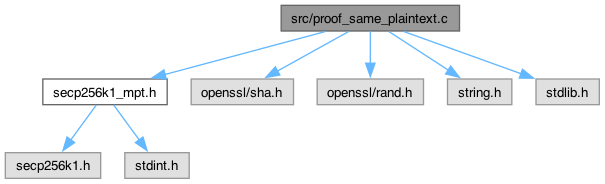
Go to the source code of this file.
Macros | |
| #define | SER_AND_HASH(pk) |
Functions | |
| static int | pubkey_equal (const secp256k1_context *ctx, const secp256k1_pubkey *pk1, const secp256k1_pubkey *pk2) |
| static int | generate_random_scalar (const secp256k1_context *ctx, unsigned char *scalar) |
| static void | build_same_plaintext_hash_input (const secp256k1_context *ctx, unsigned char *e_out, const secp256k1_pubkey *R1, const secp256k1_pubkey *S1, const secp256k1_pubkey *P1, const secp256k1_pubkey *R2, const secp256k1_pubkey *S2, const secp256k1_pubkey *P2, const secp256k1_pubkey *T_m, const secp256k1_pubkey *T_r1_G, const secp256k1_pubkey *T_r1_P1, const secp256k1_pubkey *T_r2_G, const secp256k1_pubkey *T_r2_P2, const unsigned char *tx_context_id) |
| int | secp256k1_mpt_prove_same_plaintext (const secp256k1_context *ctx, unsigned char *proof_out, const secp256k1_pubkey *R1, const secp256k1_pubkey *S1, const secp256k1_pubkey *P1, const secp256k1_pubkey *R2, const secp256k1_pubkey *S2, const secp256k1_pubkey *P2, uint64_t amount_m, const unsigned char *randomness_r1, const unsigned char *randomness_r2, const unsigned char *tx_context_id) |
| Generates a proof that two ciphertexts (under different keys) encrypt the same secret amount 'm'. | |
| int | secp256k1_mpt_verify_same_plaintext (const secp256k1_context *ctx, const unsigned char *proof, const secp256k1_pubkey *R1, const secp256k1_pubkey *S1, const secp256k1_pubkey *P1, const secp256k1_pubkey *R2, const secp256k1_pubkey *S2, const secp256k1_pubkey *P2, const unsigned char *tx_context_id) |
| Verifies a proof that two ciphertexts encrypt the same secret amount. | |
Detailed Description
Zero-Knowledge Proof of Plaintext Equality (1-to-1).
This module implements a multi-statement Sigma protocol to prove that two different ElGamal ciphertexts encrypt the same underlying plaintext amount, potentially under different public keys and using different randomness.
Statement: Given two ciphertexts \( (R_1, S_1) \) and \( (R_2, S_2) \) encrypted under public keys \( P_1 \) and \( P_2 \) respectively, the prover demonstrates knowledge of scalars \( m, r_1, r_2 \) such that:
- \( R_1 = r_1 \cdot G \) and \( S_1 = m \cdot G + r_1 \cdot P_1 \)
- \( R_2 = r_2 \cdot G \) and \( S_2 = m \cdot G + r_2 \cdot P_2 \)
Protocol Logic (Shared Nonce): To prove that \( m \) is identical in both ciphertexts without revealing it, the prover uses a shared random nonce \( k_m \) for the amount commitment across both logical branches of the proof.
- Commitments:
- \( T_m = k_m \cdot G \) (Shared commitment to amount nonce)
- \( T_{r1,G} = k_{r1} \cdot G \), \( T_{r1,P1} = k_{r1} \cdot P_1 \)
- \( T_{r2,G} = k_{r2} \cdot G \), \( T_{r2,P2} = k_{r2} \cdot P_2 \)
- Challenge: \( e = H(\dots \parallel T_m \parallel \dots) \)
- Responses:
- \( s_m = k_m + e \cdot m \) (Shared response for amount)
- \( s_{r1} = k_{r1} + e \cdot r_1 \)
- \( s_{r2} = k_{r2} + e \cdot r_2 \)
- Verification: The verifier checks 4 equations. Crucially, the "Amount" equations for both ciphertexts use the same \( s_m \) and \( T_m \), mathematically enforcing equality:
- \( s_m \cdot G + s_{r1} \cdot P_1 \stackrel{?}{=} T_m + T_{r1,P1} + e \cdot S_1 \)
- \( s_m \cdot G + s_{r2} \cdot P_2 \stackrel{?}{=} T_m + T_{r2,P2} + e \cdot S_2 \)
Security Context: This is used when transferring confidential tokens between accounts (re-encrypting the sender's balance for the receiver) or updating keys, ensuring no value is created or destroyed during the transformation.
- See also
- [Spec (ConfidentialMPT_20260106.pdf) Section 3.3.3] Proof of Equality of Plaintexts (Different Keys, Same Secret Amount)
Definition in file proof_same_plaintext.c.
Macro Definition Documentation
◆ SER_AND_HASH
| #define SER_AND_HASH | ( | pk | ) |
Function Documentation
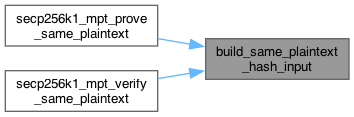
◆ build_same_plaintext_hash_input()
|
static |
Builds the challenge hash input.
Definition at line 70 of file proof_same_plaintext.c.

◆ generate_random_scalar()
|
static |

◆ pubkey_equal()
|
static |

◆ secp256k1_mpt_prove_same_plaintext()
| int secp256k1_mpt_prove_same_plaintext | ( | const secp256k1_context * | ctx, |
| unsigned char * | proof_out, | ||
| const secp256k1_pubkey * | R1, | ||
| const secp256k1_pubkey * | S1, | ||
| const secp256k1_pubkey * | P1, | ||
| const secp256k1_pubkey * | R2, | ||
| const secp256k1_pubkey * | S2, | ||
| const secp256k1_pubkey * | P2, | ||
| uint64_t | amount_m, | ||
| const unsigned char * | randomness_r1, | ||
| const unsigned char * | randomness_r2, | ||
| const unsigned char * | tx_context_id ) |
Generates a proof that two ciphertexts (under different keys) encrypt the same secret amount 'm'.
- Parameters
-
[in] ctx A pointer to a valid secp256k1 context. [out] proof_out A pointer to a 261-byte buffer to store the proof. [in] R1,S1,P1 The first ciphertext (R1, S1) and its public key (P1). [in] R2,S2,P2 The second ciphertext (R2, S2) and its public key (P2). [in] amount_m The secret common uint64_t plaintext value 'm'. [in] randomness_r1 The 32-byte secret random scalar 'r1' for C1. [in] randomness_r2 The 32-byte secret random scalar 'r2' for C2. [in] tx_context_id A 32-byte unique identifier for the transaction.
- Returns
- 1 on success, 0 on failure.
Definition at line 117 of file proof_same_plaintext.c.

◆ secp256k1_mpt_verify_same_plaintext()
| int secp256k1_mpt_verify_same_plaintext | ( | const secp256k1_context * | ctx, |
| const unsigned char * | proof, | ||
| const secp256k1_pubkey * | R1, | ||
| const secp256k1_pubkey * | S1, | ||
| const secp256k1_pubkey * | P1, | ||
| const secp256k1_pubkey * | R2, | ||
| const secp256k1_pubkey * | S2, | ||
| const secp256k1_pubkey * | P2, | ||
| const unsigned char * | tx_context_id ) |
Verifies a proof that two ciphertexts encrypt the same secret amount.
- Parameters
-
[in] ctx A pointer to a valid secp256k1 context. [in] proof A pointer to the 261-byte proof to verify. [in] R1,S1,P1 The first ciphertext (R1, S1) and its public key (P1). [in] R2,S2,P2 The second ciphertext (R2, S2) and its public key (P2). [in] tx_context_id A 32-byte unique identifier for the transaction.
- Returns
- 1 if the proof is valid, 0 otherwise.
Definition at line 201 of file proof_same_plaintext.c.